
As this year draws to a close, many people begin thinking about setting goals for the new year. The media is full of new plans, fresh intentions and a sense that we should be ready to move forward.
There is often a quiet pressure in the air and lots of advice in the media, and societal pressure to do this, or stop doing that. But before rushing ahead, there is something deeply powerful about pausing first.
Not to judge the year that has passed.
Not to label it a success or a failure.
But to listen to it.
Because the year just lived has something to teach you.
Before you plan the future, review the past year
When it comes to reflective goal setting, reviewing the past year is not about dwelling. It is about understanding where you are and where you have come from and that is important if you want to move forward.
So often, we are encouraged to move quickly on from what didn’t work. To push forward, try harder and aim higher. But reflection allows us to notice patterns, lessons and quiet achievements that might otherwise be missed.
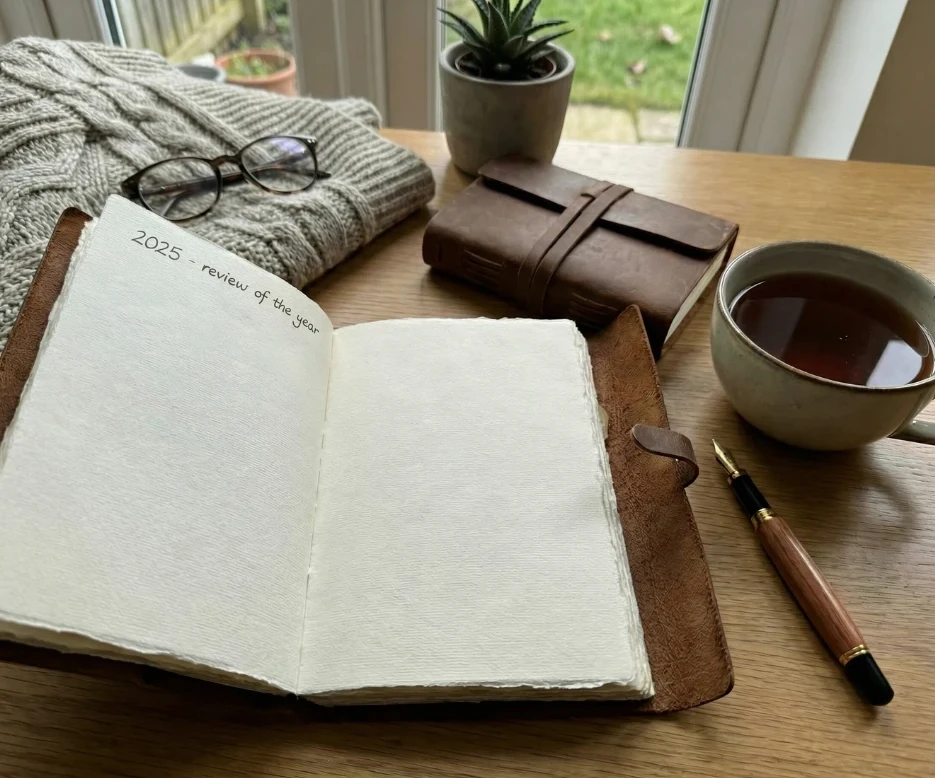
You might like to begin with a simple journalling practice. Make a cup of tea, sit somewhere comfortable, and allow yourself to write honestly. Allow what you want to say to come through unedited.
You could explore questions such as:
- What moments brought me the most peace or joy this year?
- Is there anything I regret and why?
- When did I feel most aligned with myself?
- What drained my energy or felt out of step with who I am?
- What did this year teach me about myself?
- What am I quietly proud of?
This kind of journalling for self-reflection helps you see the year as a teacher, rather than a judgement or verdict on your progress.
Letting go of “good years” and “bad years”
From a spiritual perspective, years are not something we pass or fail.
Some years are expansive and outward-facing. Others are quieter, more internal. Some ask us to build. Others ask us to rest, heal or reassess.
If the past year did not end up looking how you originally hoped, it does not mean it was wasted. It may simply have been doing deeper work beneath the surface and that there were lessons to learn.
Before moving into setting intentions for the new year, it can help to consciously release:
- Expectations that no longer fit
- Goals that were never truly yours
- The belief that you should be further along by now
Letting go of ‘shoulds’ and ‘should nots’ is not failure. It is alignment with your true self because your true self does not judge you in the way that society or other people do.
Starting the new year with stillness, not pressure
A mindful approach to setting goals for the new year begins with stillness.
Meditation, even for a few minutes, allows you to step out of mental noise and into clarity. This does not need to be complicated.
You might simply:
- Sit comfortably
- Focus on your breath
- Ask quietly, “What is being asked of me next?”
- Notice what arises without forcing answers
Meditation for clarity creates space for goals that feel more aligned with who you are rather than ones that feel imposed on you by others.
Setting intentions before taking action
Rather than starting with outcomes, try beginning with intention.
Instead of asking:
“What do I want to achieve?”
You might ask:
“How do I want to live and feel this year?”
This is the heart of spiritual goal setting because it is more about who you want to become instead of the outcomes you want to achieve.
There may be an infinite number of ways that you can achieve the goal of becoming a more enlightened person. There will be an infinite number of outcomes that you personally cannot even imagine (but the universe can). Whereas, there are a very limited number of ways to achieve a particular outcome, especially if it is so specific but doesn’t define who you will be when you get there. So it would be better to go for the infinite ways of achieving the goal.
This does not mean you cannot have specific goals, but just be flexible enough to leave room for manoeuvre and always include how you want to feel and who you want to become.
Intentions act as your inner compass. They guide your choices even when plans change. From a Law of Attraction perspective, intention aligns your energy first, allowing action to flow more naturally and from an inspired place
How to set realistic goals that support your nervous system
Many goals fail not because of a lack of motivation, but because they overwhelm our nervous system in its current state.
Learning how to set realistic goals means noticing how your body responds to them.
Helpful questions include:
- Does this goal feel supportive or pressurising?
- Does it energise me or drain me?
- Can it be broken into smaller, kinder steps?
Gentle goal setting prioritises sustainability over intensity so that the goals we set are something we know we can achieve.
The power of small, consistent shifts
Small, consistent actions can create profound change.
Ten minutes of journalling.
Fifteen minutes of meditation.
One conscious choice (something to do or not to do), repeated often.
Rather than setting many goals, you might choose:
- One inner focus
- One outer focus
- One habit that supports both
This approach builds trust in yourself, which is the foundation of real transformation.
Journalling as a living guide through the year
I highly recommend starting a journal to help you through the coming year. Journalling is not about fixing yourself, having a moan or writing a best seller. It is about listening to yourself and considering your life with honesty and purpose.
You might use journalling throughout the year to:
- Reflect on whether your goals still feel aligned
- Notice emotional or energetic shifts
- Adjust intentions without judgement
Think of your journal as a companion to your mindful goal setting, not a measure of success. No one has to read it. It is your own thoughts but it can act as a record to reflect on.
Allowing goals to evolve
Goals are not contracts, and they are allowed to evolve with you. The goals you set in your younger years bear no relation to the ones you are drawn to now – and that is just fine.
You are allowed to change your mind.
You are allowed to grow in new directions.
You are allowed to refine what no longer fits.
Checking in with your goals monthly or seasonally helps you stay aligned rather than rigid. So as you move into the year ahead, clarity will come through presence, not pressure.
If you begin the year grounded, tuned in, reflective and open, you are already on the right path.

A final reflection
Before you close this page, you might like to ask yourself:
What would it look like to trust my true self a little more this year?
That single question may guide you more wisely than any list of goals ever could.
Wishing you all love and light for 2026 and beyond.
Related posts
How to be the change you want to see
Ways to raise your vibrational energy
How to set goals you’ll actually achieve


Really timely article! I’ve been doing a lot of thinking about my own goals lately and this article kind of put words to what I’ve been feeling. Personally, I’m trying to get a lot better at badminton this year while also figuring out how to make more money and be smarter financially. I love how you talked about how goals are supposed to grow with you. I’m curious how you might balance personal growth goals with financial ones without burning out. Do you focus on one at a time or try to build routines that support both? Thanks for sharing this!
Hi Kevin. Thanks for reading the article and sharing your own experience. I really try to find goals that align with who I want to be nowadays, but that does include financial freedom as that would allow me to do so many great things. For me, working on myself and trusting in the universe is a huge part of the process and I have learned to work with the energy flow rather than against it. Have a look at this: https://thecreativechoice.org/… it may help. All the best with the badminton too. Thanks. Gail
Reflect, Reset, and Realign presents a balanced approach to New Year goal-setting by focusing on awareness rather than pressure. It encourages reflecting on the past year to gain clarity, resetting by letting go of habits or goals that no longer serve a purpose, and realigning goals with current values and priorities. This method promotes intentional, realistic, and sustainable growth, making it a healthier alternative to traditional New Year’s resolutions.
Thank you for your kind comments here and I’m pleased that you can align with some of the ideas in this post. I hope that you found something to work for you and your own goals going into 2026. All the best. Gail
Setting goals for the New Year always feels so daunting. It feels burdensome. But, I love you you suggest we not label the past year a success or a failure. Rather, you say to “listen to it.” This is so helpful for me. I am acutely aware of my shortcomings and difficulty “adulting”. I’m easing myself into 2026, and leaning into a couple goals — such as writing short frequent content for my blog (I can get too carried away and spend 12 hours writing — then I won’t do it for four months — not exactly pleasing to the algorithms). And, continuing to run a couple times a week. Thanks for the encouragement.
You’re very welcome Ali. I’m glad that you liked the post and got something from it. I think you will find it better if you can set aside some time to write consistently, as the algorithms do prefer that, as you say. I’m sure you’ll do it. All the best. Gail
Hello Gail , nice to read your article here. I am feeling very relaxed now having read this. I am just sitting doing nothing right now (after I finish this comment anyway 😀). I guess it is best to think of our past years simply as the time we had to get through to get to where we are now. Resetting and realigning my life is something I really have to think about though. Spending less on things I do not really need is something I already started to do.
Anyway, I do not want to be rambling here so , until next article ( I will read more here),
MAC
Hi MAC, thanks again for reading the article and I’m glad you have started to make changes in your life, especially if they are turning away from things you no longer need to do or make you happy. Our attention is really important and valuable and it’s very powerful too. That’s why so many people are competing for it, but the prudent person understands this and is discerning with their attention and focus. After all, “where focus goes, energy flows”. That’s true for postiive and negative things, which is why we need to choose wiesly. Sounds like you are though. All the best. Gail